
Finding Clarkstown Residents From Records
A Clarkstown residents search changes with the fact in hand. Start with the Town Assessor when there is a street number, owner name, or parcel identifier. Start with the Rockland County Clerk when a deed book and page, a seller, or a recorded transfer is known. A dated library directory, newspaper notice, obituary, or census entry is the better first stop for a family-history question. Each source describes a different relationship to an address. The assessor identifies the person assessed for a parcel. The deed index names recorded parties. A directory may identify a subscriber or household at a particular time. None supplies a complete current list of everyone at an address.
Clarkstown is a town of hamlets inside Rockland County. New City is both a Clarkstown hamlet and the county-government center, while Congers, Nanuet, Bardonia, Valley Cottage, West Nyack, Rockland Lake, and Central Nyack can appear as mailing places. Keep the town name, the mailing city, the situs address, and the legal parcel description in separate notes. A match becomes more reliable when the name, address, date, and record type agree across two independent sources.
- Search the Clarkstown assessment search by owner, legal address, or parcel ID.
- Save the situs address, tax mailing address, parcel ID, and deed reference before moving to another system.
- Use the Rockland indexed-record search to locate recorded parties and the matching instrument.
- For an old household, ask the New City Library Rockland Room for its cross-reference directories, telephone books, newspapers, and census tools.
- When an existing Town file is not online, send a narrow written request through the Clarkstown FOIL route or ask the named custodian for its copy procedure.
Clarkstown Resident Record Keepers
Three offices provide the most useful starting evidence for Clarkstown residents. The Assessor maintains current parcel and ownership data. The Rockland County Clerk keeps land, court, map, judgment, and archival series, including deeds and mortgages listed from 1798 forward. The Board of Elections maintains the registration database, but its personal lookup is not a street roster. The Clarkstown street directory follows the address trail in more detail when the search is about one road or block.
Rockland County Clerk
1 South Main Street, Suite 100
New City, NY 10956
(845) 638-5070
Rockland Board of Elections
11 New Hempstead Road
New City, NY 10956
(845) 638-5172
Clarkstown Assessor Search Fields
The Town’s property search is a three-path form. It accepts one alternative at a time, not a broad combined search. For an address, enter the number and street name without the road-type suffix. The official example is “55 Maple,” not “55 Maple Road.” An owner result can contain both a mailing address and the property’s situs address. That difference matters when someone owns a Clarkstown parcel but receives tax mail elsewhere. The assessment record also carries physical and value data, a parcel identifier, and often a deed book and page for the next search.
The official assessment interface shows the three search choices used for a Clarkstown parcel.
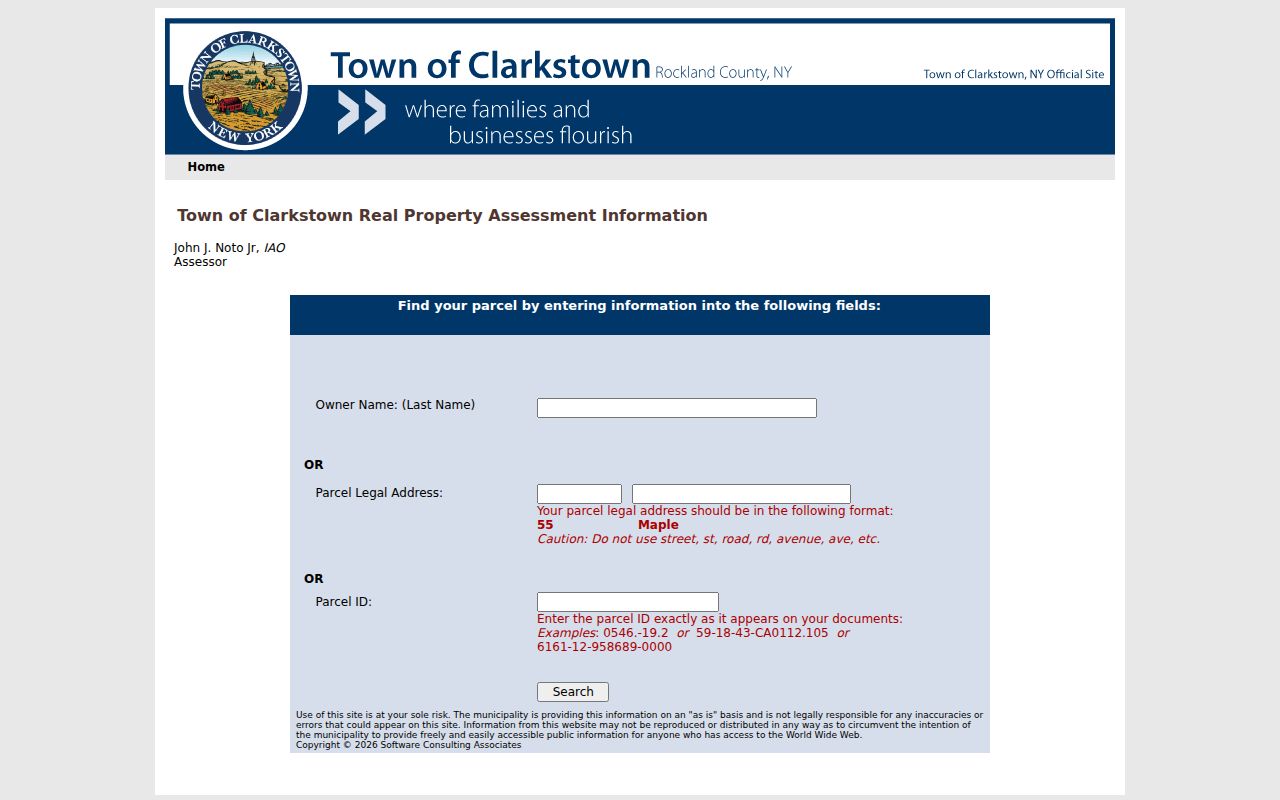
Those separate choices help prevent a name result from being mistaken for an address result.
| Field | How it works |
|---|---|
| Owner Name | Enter the assessed owner’s last name. |
| Parcel Legal Address | Enter number and street only, omitting Street, Road, Avenue, and similar suffixes. |
| Parcel ID | Enter the identifier exactly as it appears in an official document. |
Clarkstown Parcels Lead to Deeds
A parcel is the land unit used by the assessor. Its situs address is the physical location, while the tax mailing address is where the assessed owner receives correspondence. The Rockland County Clerk warns that section, block, and lot references in its digital system may not be verified. Confirm that identifier with the Town Assessor before using it as the bridge to a deed. Then search the owner in both grantor and grantee roles, compare the recording date and legal description, and keep the book/page or instrument number with the result.
The County’s indexed-record landing page is the online doorway for land records, court records, maps, naturalization material, notary records, and judgments.
The Clarkstown FOIL Center shows the separate Town request channel used to submit, track, and download responsive records.
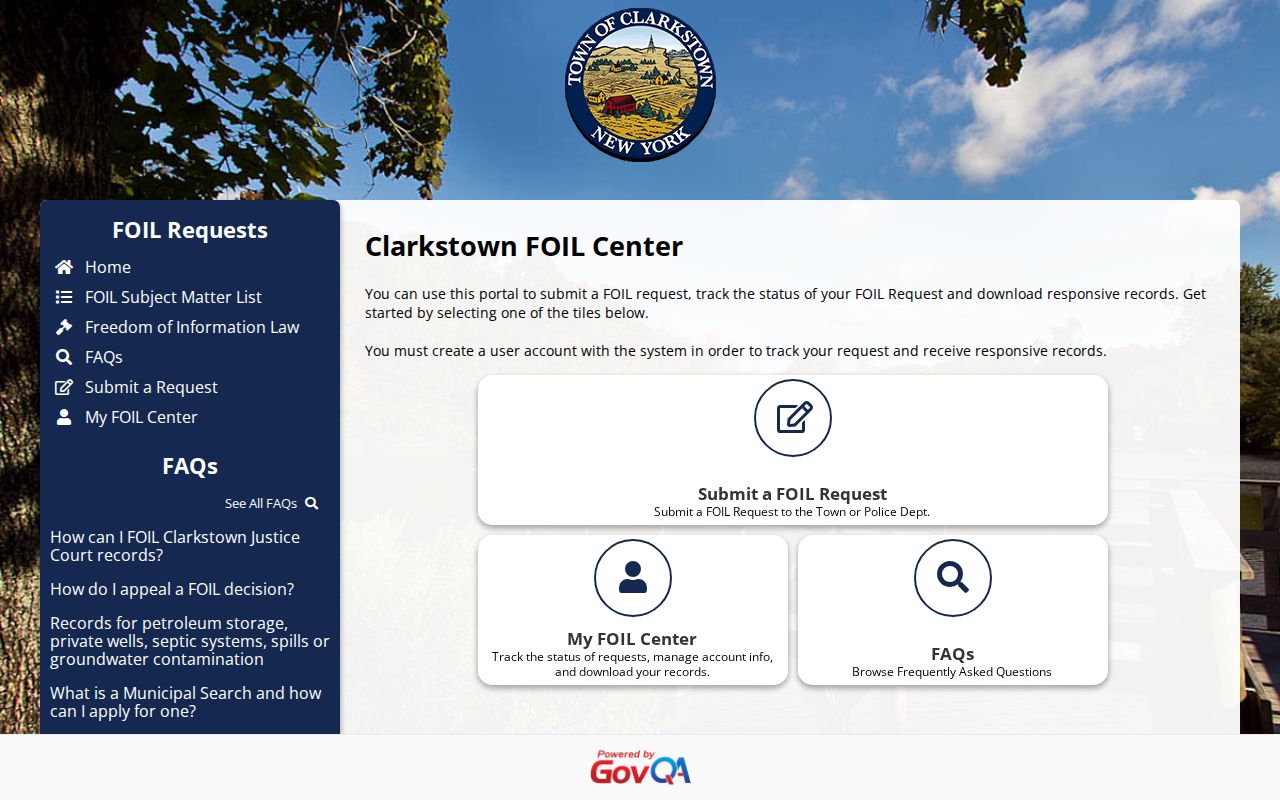
The Town FOIL Center shown here is a separate channel for Town and Police records when an existing municipal file is needed.
For a County Clerk copy, the documented certified-copy request charges $5 for a new name search, $5 for the first four pages of each document, and $1.25 for each additional page. Older material can also require the courthouse counter or the Rockland County Archives in Pomona. A recorded party or a deed mailing address is evidence connected to a transaction, not automatic proof of present residence.
Clarkstown Voter Lookup Limits
The New York voter tool is meant for a registered voter’s own status, poll site, and mail-ballot information. It requires a county, last name, first name, date of birth, and ZIP or address information. It does not provide a browseable list for a Clarkstown street. A nonmatch may reflect a spelling, date-of-birth, address, or status issue. Contact the Rockland Board of Elections rather than treating it as proof that a person has not lived in Clarkstown.
The New York State voter lookup asks for identifying information before it returns personal registration or polling information.
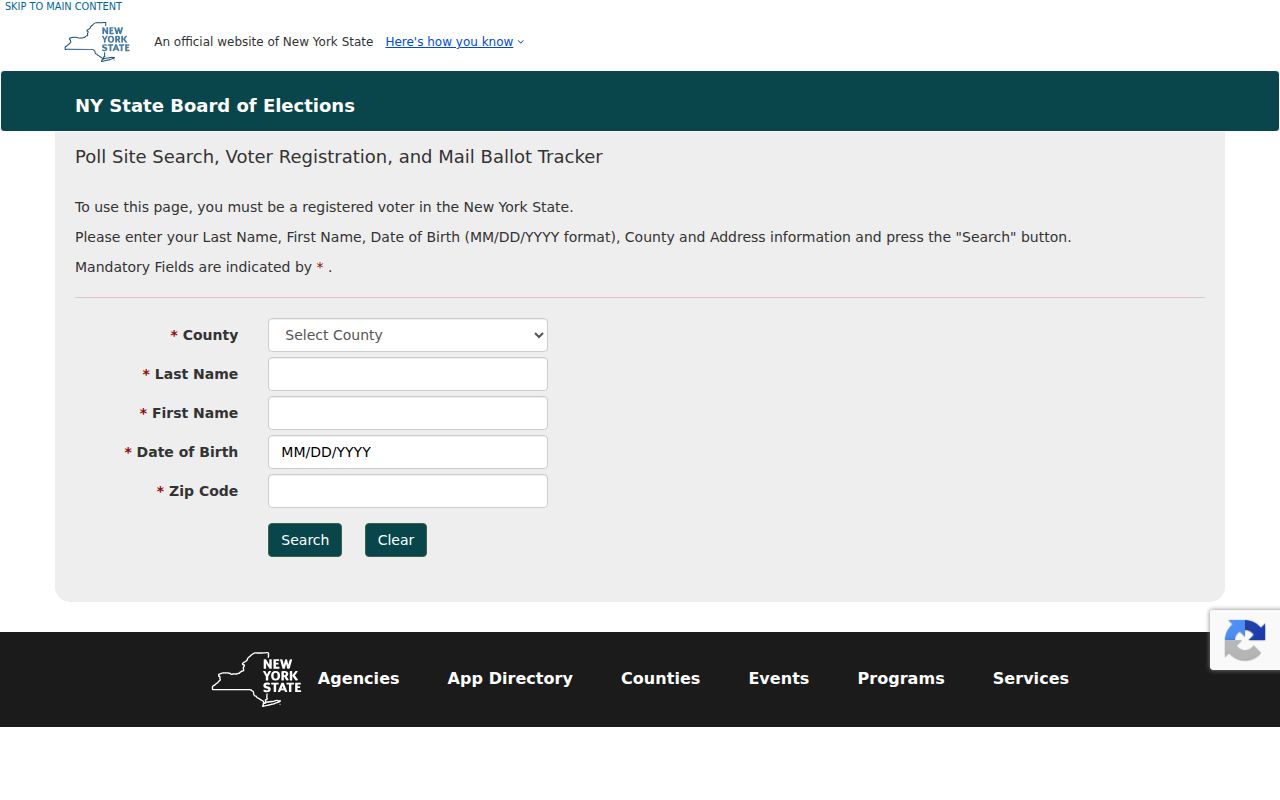
The required county, name, date, ZIP, and address inputs show why it is not a public Clarkstown resident roll.
Election Law § 3-103(5) limits use of information derived from voter registration records to an elections purpose. A request for voter data needs that statement and should name a time period, geography, and requested format. The state describes the data output as ASCII comma-delimited with a file layout. Confidential voters and Address Confidentiality Program participants may have information withheld or use a substitute address.
Current Clarkstown Resident Sources
There is no one master Clarkstown residents directory. The sources below are useful because each answers a narrow question. Property records show assessed ownership. Recorded instruments show parties to a transaction. Court files show a named party only when the case and information are public. Historical directories and newspapers supply time-specific context. Use the source that matches the question, then verify a lead with the custodian that created it.
| Clarkstown source | What it can confirm | Keeper | Access channel |
|---|---|---|---|
| Assessment roll and parcel card | Assessed owner, situs, tax mailing address, parcel details | Clarkstown Assessor | Online search, phone, or counter |
| Recorded land index | Grantors, grantees, document dates, legal descriptions | Rockland County Clerk | Online, courthouse, or copy request |
| Public court and estate records | Case party, file history, public disposition or estate role | NYS courts and clerks | eCourts, NYSCEF, WebSurrogate, or clerk |
| Cross-reference and telephone volumes | Historical address or subscriber evidence | New City Library | Rockland Room reference access |
| Vital records | Eligible certificate or genealogy evidence | Town Clerk or NYSDOH | Custodian-specific form and proof |
One person’s name needs a different sequence of checks. The Clarkstown resident lookup uses the assessor, deed index, courts, vital routes, and historical sources as a verification chain.
Clarkstown Court and Estate Names
For a public court hit, retain the court, index or file number, county, case type, dates, and disposition. WebCivil Local supports local civil searches; WebCivil Supreme covers civil Supreme Court records; NYSCEF guest search is a route to e-filed Supreme Court materials. WebSurrogate can search an estate by party name, file number, old index, index book, or testator name for safekeeping wills. A party hit does not establish a Clarkstown address or a finding against that person.
Rockland Surrogate’s Court is useful for estate and heir research because a public file can identify a decedent, fiduciary, interested party, or file history. Not every year or document is online. Older material and files with protected information may need a courthouse computer or clerk request. Family Court material, juvenile records, sealed favorable criminal dispositions, and protected victim information have separate restrictions. The safest result is a precise case reference followed by a request to the proper clerk.
Clarkstown Vital Record Routes
Clarkstown’s Town Clerk is the local registrar for local births, deaths, marriages, and marriage licenses. New York State Department of Health is the statewide route for events outside New York City. The correct route depends on the purpose. A current certified copy is restricted to eligible requesters. A genealogy copy is not certified and follows different time rules. For outside-NYC genealogy requests, births are generally available after 75 years when the person is known deceased; deaths after 50 years; and marriages after 50 years when both spouses are known deceased.
The NYSDOH genealogy page separates family-history copies from the certified-copy channel.
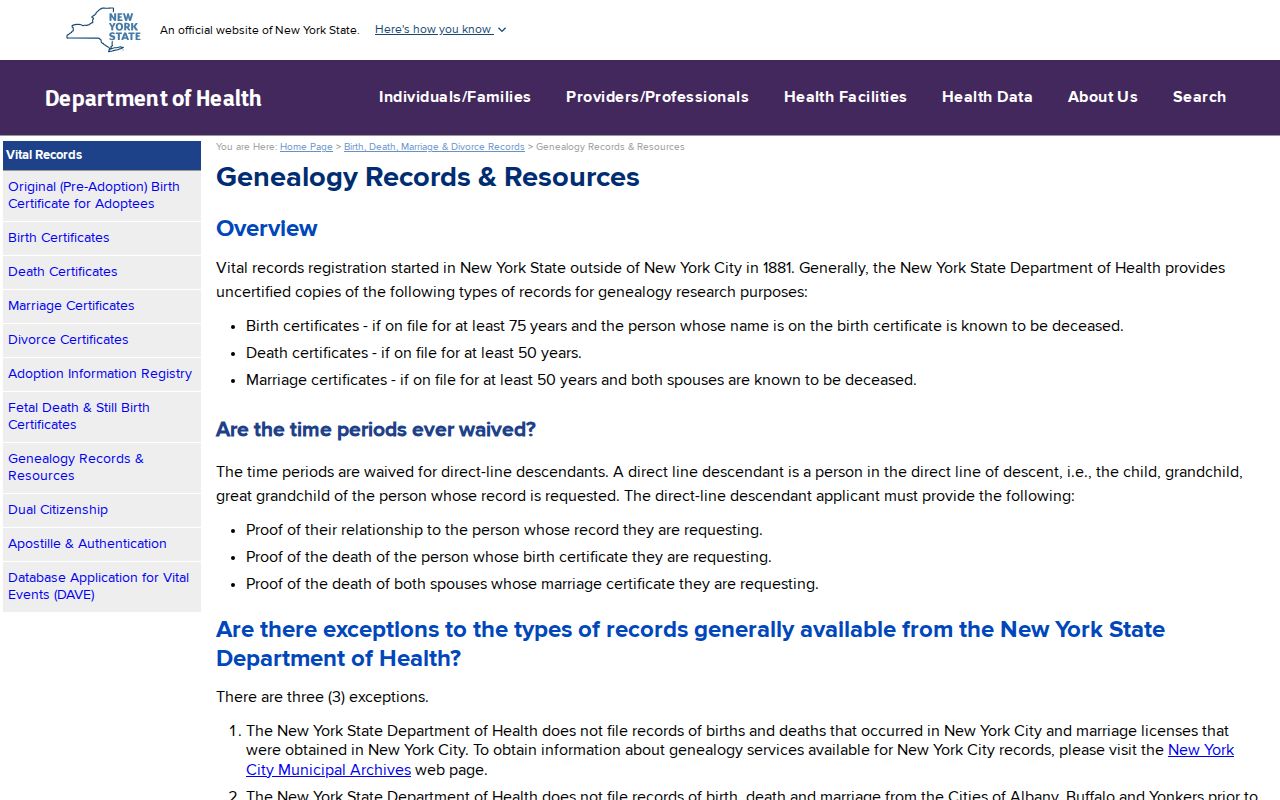
The state material makes clear that eligibility, proof, fee, and processing path vary with the requested record.
NYSDOH lists $30 mail certificates and states regular mail handling is generally 10 to 12 weeks. Its genealogy search fees start at $22 for one to three years and rise with the requested search span; genealogy processing may take eight months or longer. A direct-line descendant can seek an exception with relationship and death proof. The Rockland County Archives also lists a historical marriage series for 1908 to 1935, while a marriage license remains with the issuing town.
Clarkstown Names Beyond Portals
New City Library’s Rockland Room is the local research desk when a portal has no answer. Its documented holdings include Rockland County telephone books from 1910 through 1998, Rockland Cross Reference Directories from 1978 through 1999, local newspapers, family histories, maps, obituary requests, census material, and genealogy tools. The cross-reference set is particularly useful because it works from an address to an occupant or subscriber. Ask for a street-number search and give the hamlet, old spelling, nearby cross street, and approximate year.
The Rockland Room also links readers to FamilySearch, HeritageQuest, historical newspapers, and New York Heritage, while Ancestry Library Edition is available in the library. The Genealogical Society of Rockland County adds cemetery, church, funeral-home, census, and naturalization resources. These sources document an era, not a universal roll. Pair any directory entry with a deed, assessment, obituary, probate file, census, or vital record before drawing a family conclusion.
- Roll
- An official list or assessment record created for a defined public purpose.
- Index
- A finding aid that points to a record, not always the full record image.
- Criss-cross directory
- A reverse directory arranged by street address rather than surname.
- Parcel
- A defined tract of land used in assessment and mapping records.
Clarkstown and Rockland Record History
Clarkstown became an official town in 1791 after separating from Haverstraw. Rockland County was created from Orange County in 1798. That sequence matters for very old land research because an early deed or administrative record can sit in the older county system. The County Clerk and Archives list deeds and mortgages from 1798 to the present, census record books from 1800 to 1925, naturalization papers from 1812 to 1991, tax and assessment rolls from 1855 to 1964, and court series from 1847 to 2012.
Those dates are a useful map of where an old Clarkstown name might be, not a promise that every item is online. The online County Clerk system is available around the clock, but its public landing page does not state an image cutoff for every document type. When a digital search stops, use the County Clerk counter, Rockland County Records Management in Pomona, or the library and Historical Society collections. The documented archive channels are part of the search, not a last resort.
Clarkstown Mailing Places and ZIPs
New City 10956 is the county-seat and Town Hall mailing anchor, but it is not the whole Town of Clarkstown. Official sources connect other Clarkstown places with Congers 10920, Nanuet and Bardonia 10954, Nyack-area 10960, Valley Cottage 10989, and West Nyack 10994. A ZIP is a postal delivery geography, not a town or village line. An address labeled Nyack or West Nyack may need a Rockland GIS municipal-boundary check before its jurisdiction is assumed.
Use the complete street address in the USPS ZIP Code Lookup, then compare the delivery result with the assessor’s situs field and the Rockland GIS parcel layer. The Assessor form has no exposed ZIP search. The GIS Base Map searches address or tax ID and can show municipal, election, political, historic, environmental, and road layers. This separate verification prevents a post-office label from replacing the legal parcel geography.
Clarkstown Property Alert and Copies
The County Clerk’s PropertyCheck service can send an email when a document matching a name or property address is recorded. It is a useful way for an owner to notice a new filing. It is not a title opinion and does not decide whether an instrument is genuine. Review the actual record, compare the legal description and parcel details, and contact the Clerk when a question concerns the index or image.
| Official record path | Private compiled-data category |
|---|---|
| Names the custodian, record date, source, and access channel. | Can combine old filings and marketing data without showing how each item was checked. |
| Allows a reader to confirm a parcel, court file, deed, or certificate with the holding office. | Can merge people with similar names or retain stale address history. |
| Provides stated limits, redactions, and copy rules. | May omit protected participants and is not proof of identity or residence. |
For a suspicious deed-related letter, inspect the Clerk’s record directly and preserve the document or solicitation. The New York Attorney General, Sheriff, and District Attorney are the documented escalation channels for suspected deed theft. The State Comptroller’s unclaimed-funds search is also free, so a fee demand after a name match should be treated with care.
Clarkstown Address Privacy Boundaries
Public access has real limits. The New York Address Confidentiality Program can give eligible participants a substitute Albany mailing address, mail forwarding, and legal-process service. Confidential voter registration can also protect a voter’s address. DMV personal information has separate restrictions, and court files may be sealed or confidential. An absent address or a substitute mailing address is not evidence that someone left Clarkstown.
New York FOIL, Public Officers Law Article 6, opens existing agency records subject to exemptions. Clarkstown Town Code Chapter 224 requires a written request that reasonably describes the records. The Town must grant, deny, or acknowledge the request within five business days; inspection, search, and certification are free under the local rule, while ordinary copies up to 9 by 14 inches are 25 cents per page. Ask for a specific existing file, not a newly created resident list.
Historical Clarkstown Directory Collections
For a past household, Clarkstown’s strongest documented address source is the Rockland Cross Reference Directory run, 1978 through 1999, held in the New City Library Rockland Room. It is a reverse, or criss-cross, directory: begin with the address and compare adjacent years for initials, units, subscriber changes, and moves. County telephone books from 1910 through 1998 extend the search but do not include every household. The Rockland Journal News microfilm reaches 1850 to the present, with additional local newspaper runs for earlier decades.
The detailed collection years, physical access, and household-tracing method are on the Clarkstown city directory page. For earlier gaps, combine federal census years through 1950, New York census and enumeration material, County Archives tax rolls, deeds, cemetery sources, and church or newspaper records. A dated directory entry is a valuable lead because it anchors a person or subscriber to a place and year. It still needs corroboration when the question is ownership, family relationship, or current residence.